1. Headline Resonance (6 marks) Find one (1) headline you recently encountered that you felt was effective.
a) Provide the exact headline
Dead Women Are Turning Up in New England Beach Towns. Police Deny a Pattern, But Locals Fear a Serial Killer
b) Explain why it resonated with you
The first part of this headline caught my eye because I consume a lot of true crime content so it felt familiar, and by the time I got to the end I felt like I needed to read the article to find out what’s happening. The opening phrase “dead women are turning up” is immediately gruesome and shocking, while “New England Beach Towns” adds a level of specificity and interest. In the next part “ Police Deny a Pattern, But Locals Fear a Serial Killer” the is strong contrast between the first and second half; the police denying a pattern while people in the town think that there’s a serial killer on the loose heightens emotional attachment and leaves me asking “why aren’t the cops doing anything?” and wanting not only to learn about the deaths but also to read about how community and authority perceptions could be so different.
c) Tie your explanation directly to specific headline elements discussed in class
This headline is effective because it uses several different concepts we discussed…
Curiosity Gap – This headline is specific enough for the audience to take interest in the story, but also leaves them with unresolved tension that they feel the need to settle. Instead of saying something vague like “police find dead bodies on a beach” they specify that they are women and the exact area they were found which makes the story feel more real and shocking. The second part also contributes to the curiosity gap because it makes the audience wonder why the police aren’t believing the community.
Contrast and conflict – this headline effectively uses contrast phrasing with two opposing frames; “Police Deny a Pattern” and “Locals Fear a Serial Killer”, which intensifies shock value and creates another level of curiosity. By adding this second part, the headline not only leaves people asking “who did it” but also “why aren’t the cops believing the community?”. It also creates a sense of conflict between locals and police, which may spark extra emotion in some people
Discover Intent – This headline successfully invites people to read the attached article by presenting a specific, disturbing situation with no clear resolution and then a strong conflict between a scared community and its police force. It encourages readers to read more, resolve their questions, and possibly come up with their own theories.
2. Accuracy & Representation (4 marks) Was the headline in Question #1 An accurate representation of the article content?
a) Explain your reasoning clearly
Yes, I believe that this headline is an accurate representation of the article’s content. The article is about a close community of beach towns in New England where there have been 4 women found murdered within just a few months. The article also highlights the fact that people who live in the area suspect a serial killer because of the close proximity of the bodies found and the short time frame, and the local police denying that there is a connection between the cases despite a pattern.
Importantly, the headline does not insinuate or state anything that is not a fact. It doesn’t imply that there is a serial killer in that area, it only states what’s going on (4 women found dead), what the community suspects, and how local police are handling the situation.The contract and emotional pull of this headline feels aligned with the seriousness of the situation rather than exploitative or overly dramatic.
b) Reference course discussion on misleading vs effective headlines
In class we talked about the difference between a misleading headline and an effective one. Although it might seem tempting to overdramatize your headline to shock the viewer and get them to read further, if the article itself is inconsistent with what the headline states, the reader will feel tricked, annoyed and become less likely to engage with content from that source.
However, an effective headline uses writing techniques to pull strong emotions and tension while staying consistent with what’s actually in the article. The headline for theNew England beach town murders achieved this balance; while it highlights fear within a community, deaths, and police conflict to evoke emotions, the headline has an appropriate tone and is accurate with the story.
3. Click Motivation (8 marks)
a)Provide a different headline you recently clicked on.
Police Found Woman’s Remains in a Toolbox Thanks to a ‘Single Drop of Blood.’ Her Killer Was Living in the Same Home
b)Include the exact headline and a screenshot
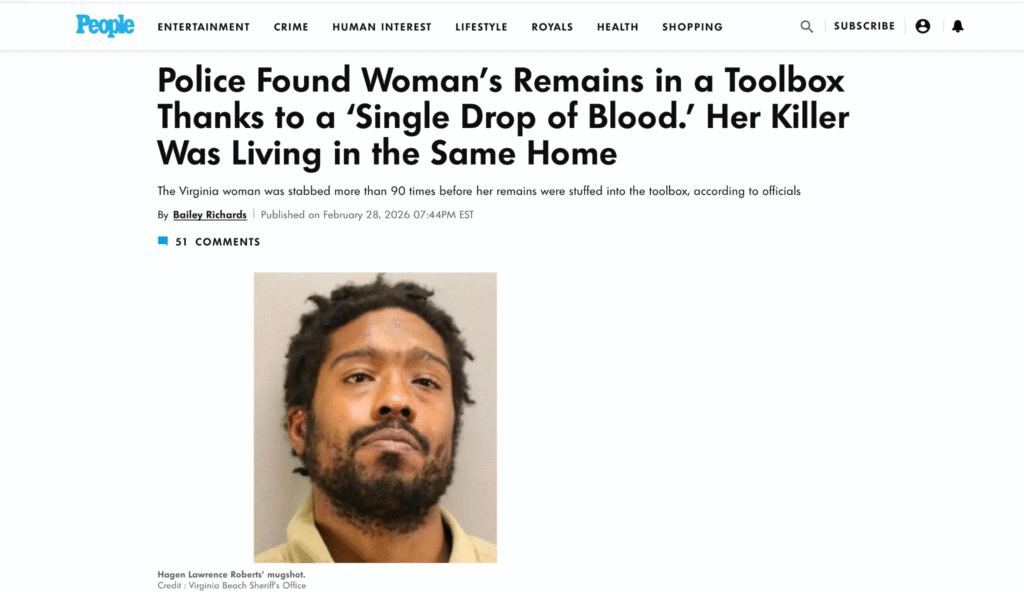
c)Explain why you clicked it, not why you liked it
I clicked it because it’s shocking, has a strong curiosity gap, and catches attention quickly through concise wording and specificity.
I wanted to click this headline because within 3 seconds I was shocked and wanted to learn more about what happened. The phrase “woman found in the toolbox” was what caught my eye first because it’s highly specific and disturbing to picture. It presents a highly unusual situation that leaves me questioning “why did he do it?” “how did she fit in there?”, making me want to understand what happened. The mention of “A single drop of blood” also piqued my interest because it implies that a tiny, lucky detail led to the murder being solved, making the case feel rare and interesting.
The last part of the headline, “her killer was living in the same home” was the final phrase that drew me in adding a twist that made an already rare situation even more intense. Knowing that the killer was living in the same home as the victim left me with more questions; “who was it” “how did he fly under the radar?” and added a layer of betrayal to the story. My click was motivated by a need for resolution and details over personal interest or enjoyment.
d)Tie your reasoning directly to course concepts
According to many class discussions, viewers see thousands of pieces of content per day, so they don’t read – they scan. For an ad/article to pull a high CTR it must function as a “decision trigger”, and this headline strongly aligns with course concepts about how to write a good headline.
In class, the importance of cutting content was talked about a lot; when you write something you’re supposed to look at it and ask – what is not needed here? And to not write anything that your audience doesn’t need. The headline uses effective phrasing only and successfully grabs attention by using graphic words like “blood” “killer” and “remains” to disrupt scanning.
It also effectively uses a curiosity gap which was discussed in class; while it’s okay to “spoil” what’s in the article (because why are we hiding it) it’s also important to leave the viewer wanting or needing to know more. This headline is specific, shocking, and reveals enough information to draw the viewer in and give them an idea of what happened, but withholds full details to create a curiosity gap. For example, rather than being vague and using a phrase like “woman’s body found” the headline uses the specific phrasing “woman found in toolbox” to highlight the story’s gruesome shock and uniqueness.
Leave a Reply